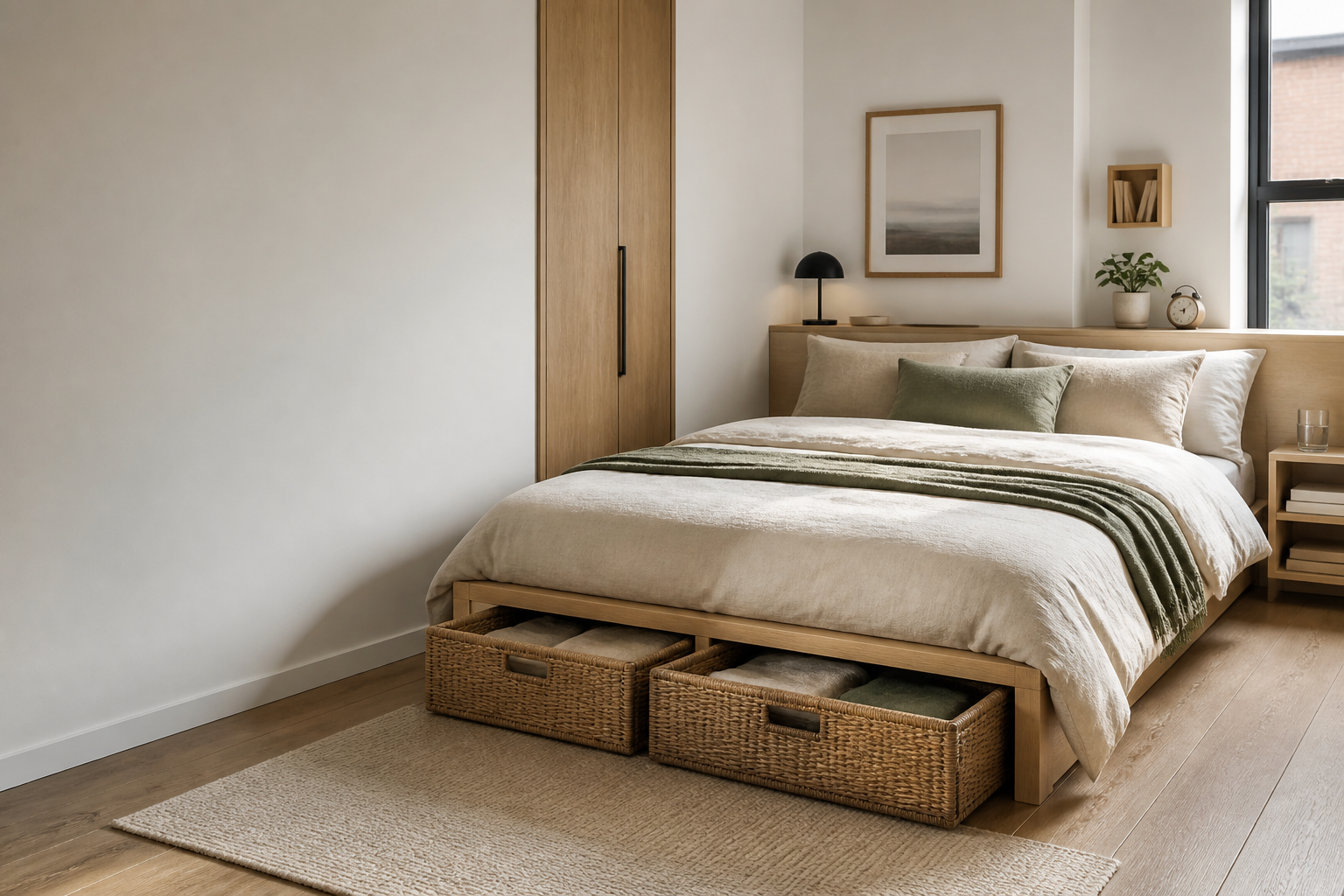
Do not begin by asking, “How can I fit all of this?” Begin with, “What does this home need to support every week?” That question separates necessary capacity from accumulation.
Two crowded homes can need opposite fixes
A capacity problem appears when every suitable storage zone is full, frequently used belongings have no stable home and clearing one surface only moves the same items elsewhere. A space-use problem appears when cupboards contain dead air, deep shelves hide what is behind them, oversized furniture blocks usable walls or low-frequency items occupy the easiest-to-reach places.
The distinction matters. Adding organizers to a home that is already over capacity creates smaller, denser piles. Decluttering a home with badly assigned storage can remove useful possessions without making daily routines easier.
Choose one category that regularly escapes onto a surface—shoes, food, laundry or paperwork. If it fits comfortably after you remove expired, broken and duplicate items, the problem was capacity. If the remaining items fit only when you change shelf depth, access or location, the problem was space use. If they still do not fit, you likely have both.
Four actions before buying another container
Define the household minimum
List what the home must support between laundry cycles, grocery trips and seasonal changes. Keep enough for real life, not every possible future.
Measure one category, not the whole home
Gather all items from one repeated problem area and compare their actual volume with the storage available. A bounded test produces a useful answer quickly.
Protect prime-access space
Reserve the easiest shelves, hooks and drawers for things used daily or weekly. Move archives, spare supplies and seasonal items farther away before adding storage.
Set a physical limit
Give the category one drawer, one shelf or one clearly sized bin. When the boundary is full, choose what leaves before expanding the footprint.
Wait until the category is edited and measured. A container is useful only when it matches the remaining volume, the access pattern and the exact opening where it will live.
Read the room, then choose the intervention
Repeat the test with two more categories. If nearly every category exceeds a reasonable boundary, reducing volume will create the biggest change. If only one or two categories fail while empty or awkward space remains elsewhere, redesign the storage assignment first.
The takeaway
Capacity is a relationship between what you keep, where it lives and how often you need it.
Get a clearer diagnosis across storage, furniture, routines and available space.
Take the free Small Home Score