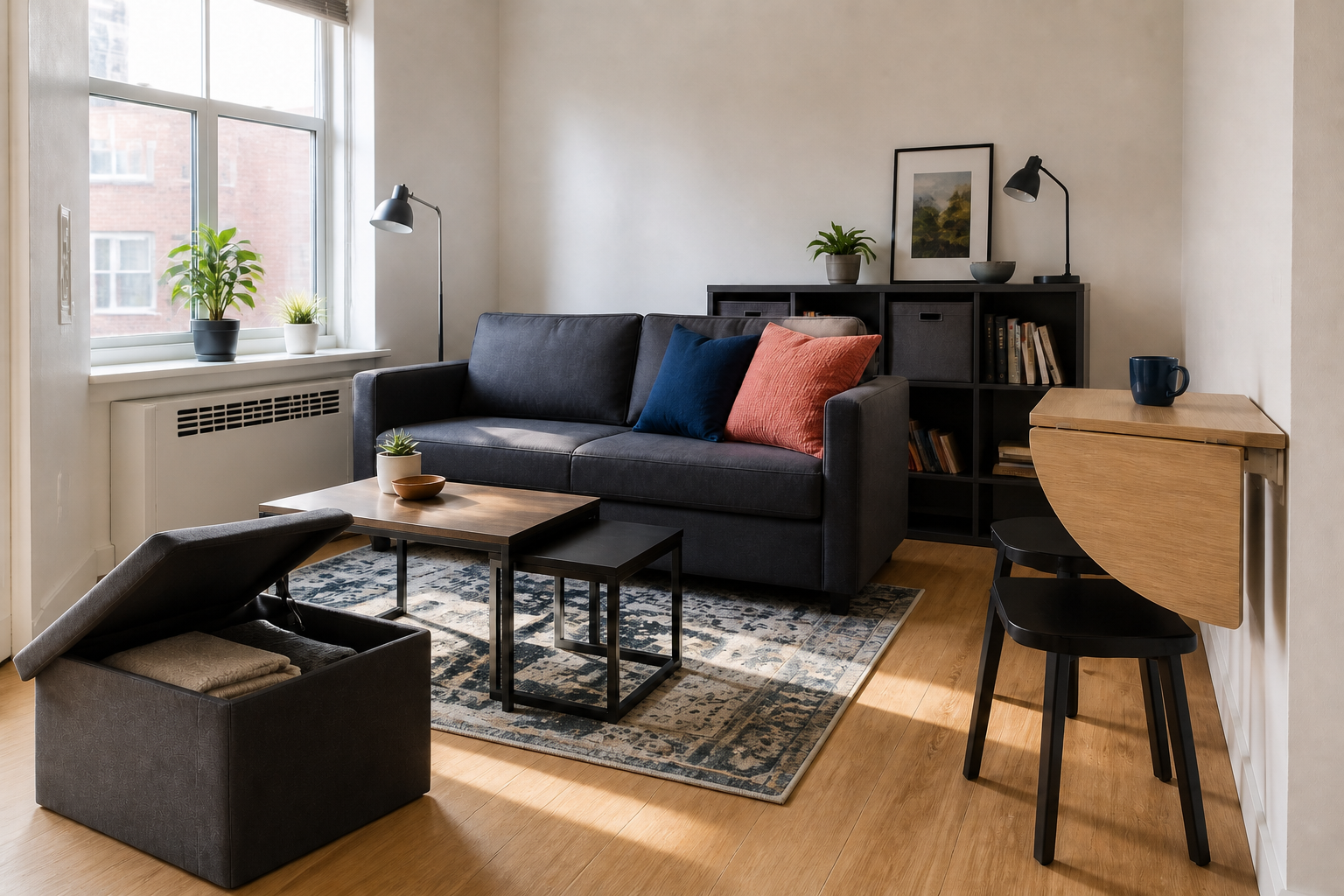
Space-saving furniture should remove a recurring problem, not merely look clever while folded. Start by naming the task, then measure the piece closed, open and while a person is using it.
How this comparison was built
We checked current manufacturer or retailer pages for the mechanism, open and closed dimensions, published availability, assembly and return limitations on August 16, 2026. We have not tested these five products hands-on, so this is an independently researched shortlist—not a performance review or a claim that one item is “best”.
The product links in this edition are direct editorial links and do not currently earn a commission. Small Space Living Lab has not been paid to include these products. If affiliate tracking is added after approval by a retailer, this notice and the relevant links will be updated before publication.
Five real products with different jobs
01 / Daily desk → dining table
The Flip — Console to Table
A shallow console that pulls away from the wall, unfolds its hinged legs and flips into a table for four to six people.
- Closed
- 47.25 × 15.75 × 29.5 in
- Open
- 47.25 × 31.5 × 29.5 in
Works when: the same wall needs to support a desk most days and dining occasionally.
Measure first: it must be pulled away from the wall before opening. Add chair and walking clearance around the full 31.5-inch depth.
Listed at US$499 and in stock when checked. Minor leg assembly; published worldwide shipping.
Check current price and availability ↗02 / Coffee table → dining height
Transforming Table 4
A wheeled hydraulic table that rises from coffee height, rotates and opens into a square dining surface.
- Closed
- 38 × 19 × 8 in
- Open
- 38 × 38 × 28.75 in
Works when: one central table genuinely needs to handle low, working and dining positions.
Measure first: the open top doubles its depth. The manufacturer’s return policy lists a 15% return fee, and the table still occupies a 38-inch square before chair clearance.
Listed from US$548 and in stock when checked. Delivered assembled; published worldwide shipping.
Check current price and availability ↗03 / Sofa work + hidden storage
Boost — Lifting Coffee Table
The top lifts toward the sofa to create a closer work or eating surface and reveal internal storage.
- Footprint
- 43.3 × 23.5 in
- Height
- 18.25 → 24 in
Works when: the daily problem is leaning over a low table to use a laptop, eat or reach essentials.
Measure first: it is not a tiny coffee table. Confirm sofa-to-table clearance and never treat the extended top as seating.
Listed at US$699 and in stock when checked. Minor leg assembly; published worldwide shipping.
Check current price and availability ↗04 / Console → table for a crowd
Junior Giant Extending Table
A narrow console with a telescopic frame and five removable leaves that can extend into a table seating up to twelve.
- Closed
- 37.4 × 17.32 × 29.72 in
- Fully open
- 37.4 × 106 × 29.72 in
Works when: a household regularly hosts people but cannot dedicate a room to a permanent dining table.
Measure first: the five leaves require separate storage, and the fully extended table needs almost nine feet before allowing space for chairs and movement.
Listed from US$2,095 and available when checked. Delivered assembled; published worldwide shipping.
Check current price and availability ↗05 / Flexible surface without a mechanism
ClickDecor Parker Nesting Tables
Two solid-wood-top tables with metal sled bases; the smaller table slides beneath the larger one when not needed.
- Nested footprint
- 17.25 × 12 in
- Overall height
- 25 in
Works when: one person needs a compact everyday side table and an occasional second surface.
Measure first: this is nesting, not folding—the larger table’s footprint never disappears. Retailer feedback is positive overall but includes some durability and scratching concerns.
Listed at US$157.99 with 28 reviews when checked. Fully assembled; retailer lists a 30-day return policy.
Check current price and availability ↗Prices and availability are snapshots, not guarantees. Confirm the current product page, delivery region, taxes, return cost and every critical measurement before ordering.
Eight rules before buying any space-saving piece
Give the piece one primary job
Name the repeated problem it must solve. “Multifunctional” is not useful if none of the functions is needed often.
Measure it closed, open and in use
Add door swings, pulled-out chairs, lifted lids, extended leaves and the space required for a person to operate the mechanism.
Find the parking place first
Folding chairs, extension leaves, nesting pieces and carts save space only when their reset position is already known.
Check the access route
Compare packaged dimensions with the building entrance, lift, staircase, hallway corners and room doorway—not only the final location.
Watch a complete mechanism demonstration
Look for the hinge, lock, handle, wheel or support that makes the transformation possible. A photograph showing two states is not enough.
Read the return cost, not just the period
Large furniture may carry restocking, collection or return-shipping charges even when a trial period is advertised.
Prefer repairable hardware
Ask whether hinges, pistons, wheels and extension mechanisms have a separate warranty and whether replacement parts are available.
Test the routine on the floor first
Mark the open footprint with painter’s tape and live around it for a day before committing to a purchase.
The five-number check
Record the available width, available depth, operating clearance, access-route minimum and reset-storage space. If a product page does not publish one of the dimensions needed to answer those questions, ask the seller before ordering.
The best transforming furniture is not the piece that changes the most. It is the piece whose everyday state is comfortable, whose second state solves a real problem and whose mechanism you will still use six months from now.
Next field note